Location context
Wider Location – Positioned in the far eastern reaches of the Bronx, the site is uniquely situated between two major expressways, offering seamless vehicular access southward and southeast toward Long Island. Just minutes away lies Pelham Bay Park — New York City’s largest public park — a vast coastal landscape featuring woodlands, sports facilities, and a full waterfront recreational complex. From picnicking and fishing to cycling and shoreline walks, the park provides a rare opportunity to engage with nature at the river’s edge, making it an unparalleled urban escape.
Narrow Location – The site occupies a distinct triangular lot at the intersection of three streets, creating a highly visible urban corner condition. Fronting a broad avenue that carries the elevated MTA train line, the building engages directly with one of the neighborhood’s most active transit corridors. Strategically positioned midway between two train stations, the site ensures exceptional access to public transportation — connecting seamlessly to the broader Bronx and Manhattan without reliance on a car. Surrounded by 3–4 story buildings, the context remains human-scaled and open, while the unique geometry of the plot lends itself to an architectural gesture that confidently concludes the block. As the last site at this three-way intersection, the project assumes a defining role in completing the urban fabric.
Plot Organization
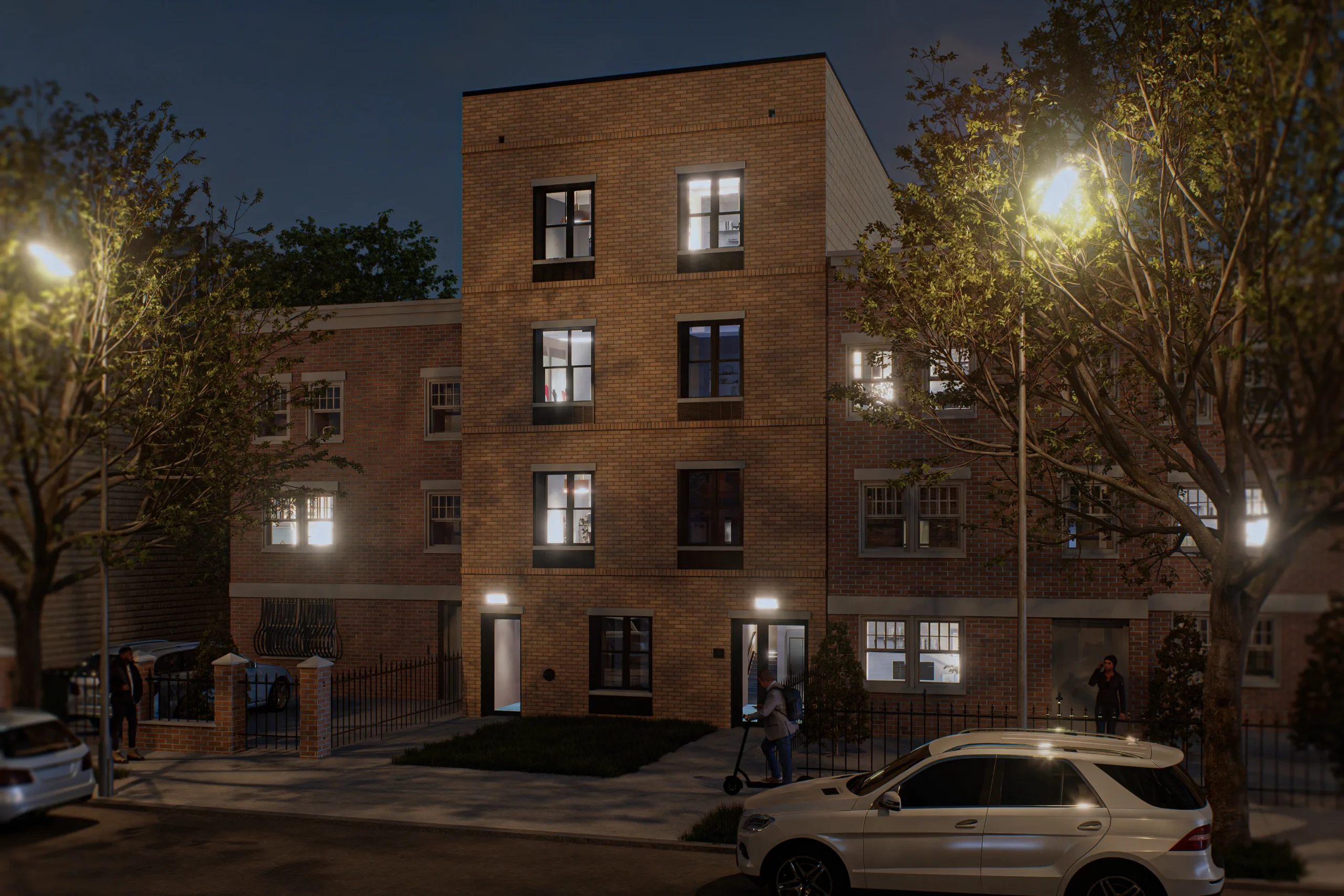
As a corner site shaped by the convergence of three streets, the triangular lot is utilized to its maximum buildable potential, leaving no space for traditional front or rear yards. Instead, the building integrates into the existing urban fabric and draws on the surrounding streetscape for its greenery and openness. Due to the sidewalk’s topographical variation, the primary façade — and main pedestrian access — is oriented toward Westchester Avenue. This west-facing frontage anchors the building to the street grid and reinforces its identity as a contextual yet prominent infill development.
Building Organization
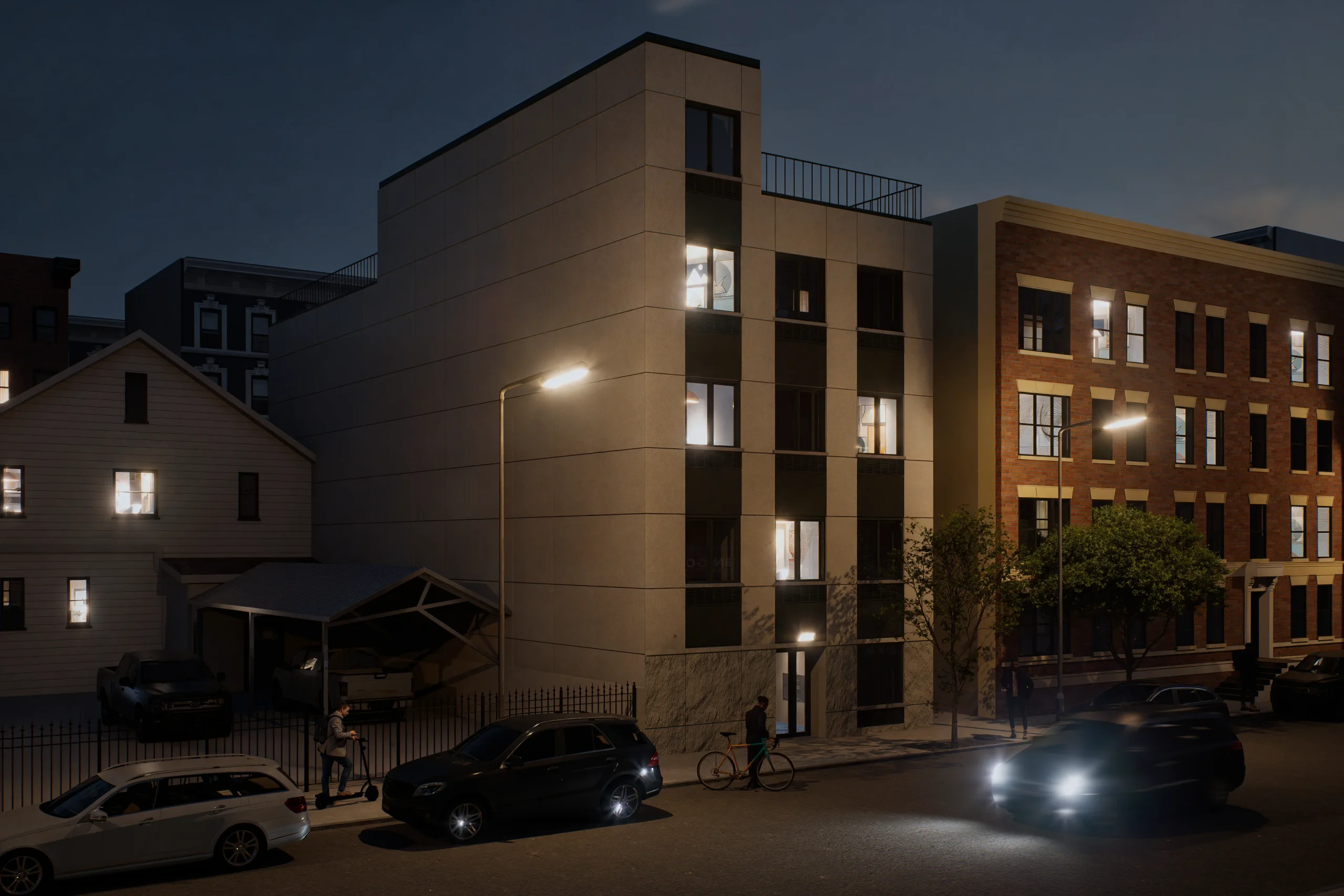
The building’s geometry is shaped by the triangular footprint of the plot, which posed a unique challenge and opportunity in organizing the interior structure and apartment layouts. The central circulation core — a vertically stacked stairwell — is positioned precisely at the heart of the building, allowing apartments to wrap around it and benefit from dual orientation in nearly every unit. This smart configuration ensures optimal daylight access, ventilation, and visual connection to the surrounding streets.
On the ground floor, the northern wing houses two ADA-compliant units — one studio and one 1-bedroom apartment — both oriented toward Westchester Avenue. South of the core, the floor plan accommodates key shared amenities, including an indoor recreational room with an adjoining bathroom accessible to all tenants, a secure bike storage area, and technical service rooms.
Floors 2 through 4 follow a consistent layout, each comprising four apartments: one generously sized 2-bedroom unit and one 1-bedroom apartment on the southern side, and two 1-bedroom apartments to the north — maximizing the building’s usable envelope while preserving spatial comfort. The structure culminates in a spacious 1-bedroom penthouse on the top floor, offering elevated views and enhanced privacy, completing the residential experience with distinction.
Organization of the Apartments
The unique geometry of the triangular plot introduced multiple angled walls and corners — rather than fighting these, the design embraces them. These slopes are thoughtfully resolved within the interior layouts, creating moments of spatial character and providing the opportunity for generous entrance zones. In the larger apartments, these angled conditions allow for the integration of built-in closets right at the threshold, offering a sense of separation from the entrance to the main living areas.
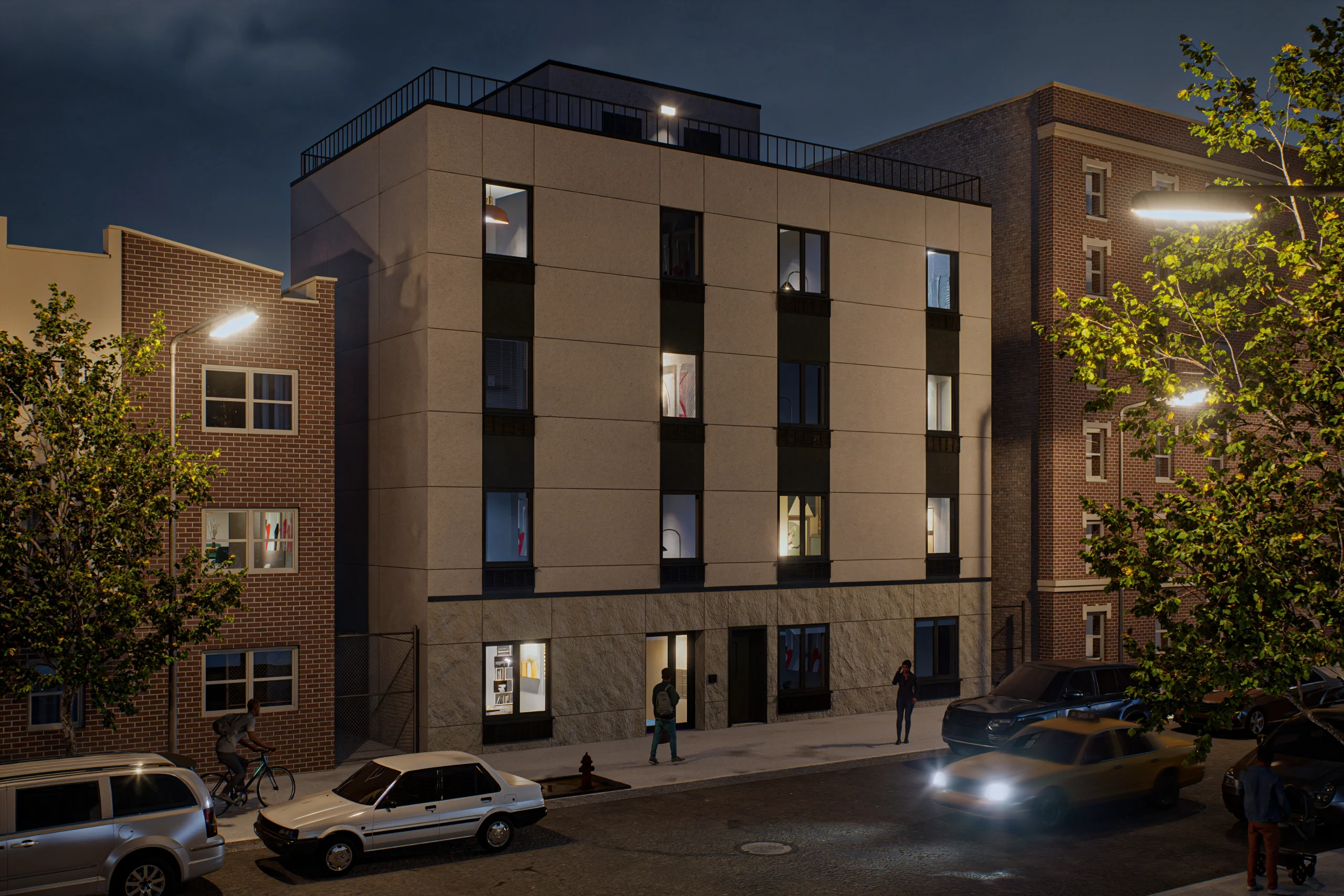
Thanks to the building’s prominent location and need for an animated façade, the apartments are richly glazed, bringing in ample natural light throughout the day. Many units benefit from more windows than typically required — particularly in kitchens and entry areas — enhancing both daylight and cross-ventilation. All apartments are equipped with PTAC units for individual heating and cooling, and in combination with the improved window layout, this ensures excellent indoor air circulation and year-round thermal comfort.
This building stands at a uniquely prominent intersection — a triangular site framed by three streets, with no immediate neighbors crowding its form. Its location, both exposed and symbolic, demanded an architectural response that balances identity, functionality, and resilience. The irregular plot became an opportunity: a sculpted form that invites light into every corner, with layouts that exceed standard expectations in both openness and livability. The abundance of windows not only animates the façade but brings in daylight from multiple orientations, while the proximity to the elevated train called for high-performance acoustic glazing — turning a potential challenge into a clear upgrade in quality. What emerges is a compact, intelligent building that confidently defines its corner — and sets a new benchmark for residential design in the area.